How to Get a Free Personalised Horoscope That Actually Means Something
For decades, the word "horoscope" conjured images of brief, vague paragraphs tucked into the back pages of daily newspapers. These generic readings, based entirely on your Sun sign, offered little more than entertainment. However, as of 2026, the landscape of astrological tools has shifted dramatically. Modern platforms utilize high-precision NASA data, complex ephemeris databases, and advanced algorithms to generate highly specific, data-driven reports.
A true personalised horoscope is not a broad prediction for one-twelfth of the global population. Instead, it is a mathematical snapshot of the solar system at the exact moment and location of your birth, known as a natal chart or birth chart. By comparing the current positions of the planets (transits) to your original natal chart, modern tools can provide highly specific guidance regarding career timing, relational dynamics, and personal development.
Image source: GaneshaSpeaks
What Information Do You Need for an Accurate Horoscope?
To generate a report that is mathematically unique to you, any reputable astrological calculator will require a specific set of data points. Omitting or estimating any of these variables significantly reduces the accuracy of the resulting chart.
The essential data points include:
- Date of Birth: The foundational metric that determines the baseline positions of the slower-moving outer planets (Jupiter, Saturn, Uranus, Neptune, and Pluto).
- Exact Time of Birth: Crucial for determining your Ascendant (Rising Sign) and the exact degree of the Moon, which moves rapidly through the zodiac.
- Birth Location (City and Country): Necessary for establishing the geographical coordinates (latitude and longitude) of your birth.
Why does location matter so much? Astrology operates on a geocentric (Earth-centered) logic. While astronomy recognizes the Sun as the center of our solar system, astrology is the study of the human experience from a specific vantage point on Earth. The intersection of your birth location's coordinates with the ecliptic (the apparent path of the Sun across the sky) determines the exact orientation of the astrological houses in your chart.
Without precise location data, the software cannot calculate which constellations were rising over the eastern horizon or culminating at the midheaven at the moment of your birth. This spatial orientation is what separates a generic planetary list from a highly structured, individualized life map.
Why Your Birth Time Is the Most Important Piece of Data
Among all the data points required, the exact time of birth is frequently the most difficult to obtain, yet it is undeniably the most critical. In astrological mechanics, the Ascendant (or Rising Sign) changes approximately every two hours. Furthermore, the specific degree of the Ascendant changes by one degree every four minutes.
The Ascendant serves as the anchor for the entire chart. It establishes the First House, which in turn dictates the sequence and rulership of all subsequent eleven houses. If your birth time is off by even thirty minutes, your chart could shift entirely, placing planets in different houses and fundamentally altering the interpretation of your career, relationships, and financial prospects.
High-quality astrological tools rely on comprehensive databases, such as the Swiss Ephemeris, to account for historical time zone anomalies. Daylight Savings Time (DST) rules were highly inconsistent prior to the late 1960s, with different counties within the same state often observing different time rules. A robust calculator automatically adjusts for these historical shifts to ensure your chart is mathematically sound.
If you do not know your exact birth time, you have a few options. You can request a long-form birth certificate from your local vital records office, which typically includes the time of delivery. Alternatively, you can consult a professional astrologer for a process called "chart rectification," where they work backward from major life events to deduce your likely birth time. If neither is possible, most free tools allow you to generate a "Sunrise Chart" or use "Solar Houses," though these methods offer a significantly reduced level of detail.
How to Read Your Personalised Birth Chart Beyond the Sun Sign
Once you input your data into a free calculator, you will be presented with a circular diagram filled with glyphs and lines. While this can appear overwhelming, understanding a few core concepts allows you to extract meaningful insights immediately.
The foundation of any personalised reading begins with the "Big Three":
- The Sun Sign: Represents your core identity, ego, and fundamental life force. It is the "engine" of your personality.
- The Moon Sign: Governs your emotional landscape, subconscious reactions, and what you need to feel secure. Because the Moon changes signs every two and a half days, it adds significant nuance to your emotional profile.
- The Rising Sign (Ascendant): Dictates your outward behavior, your physical vitality, and the "social mask" you wear when interacting with the world. It is the lens through which others first perceive you.
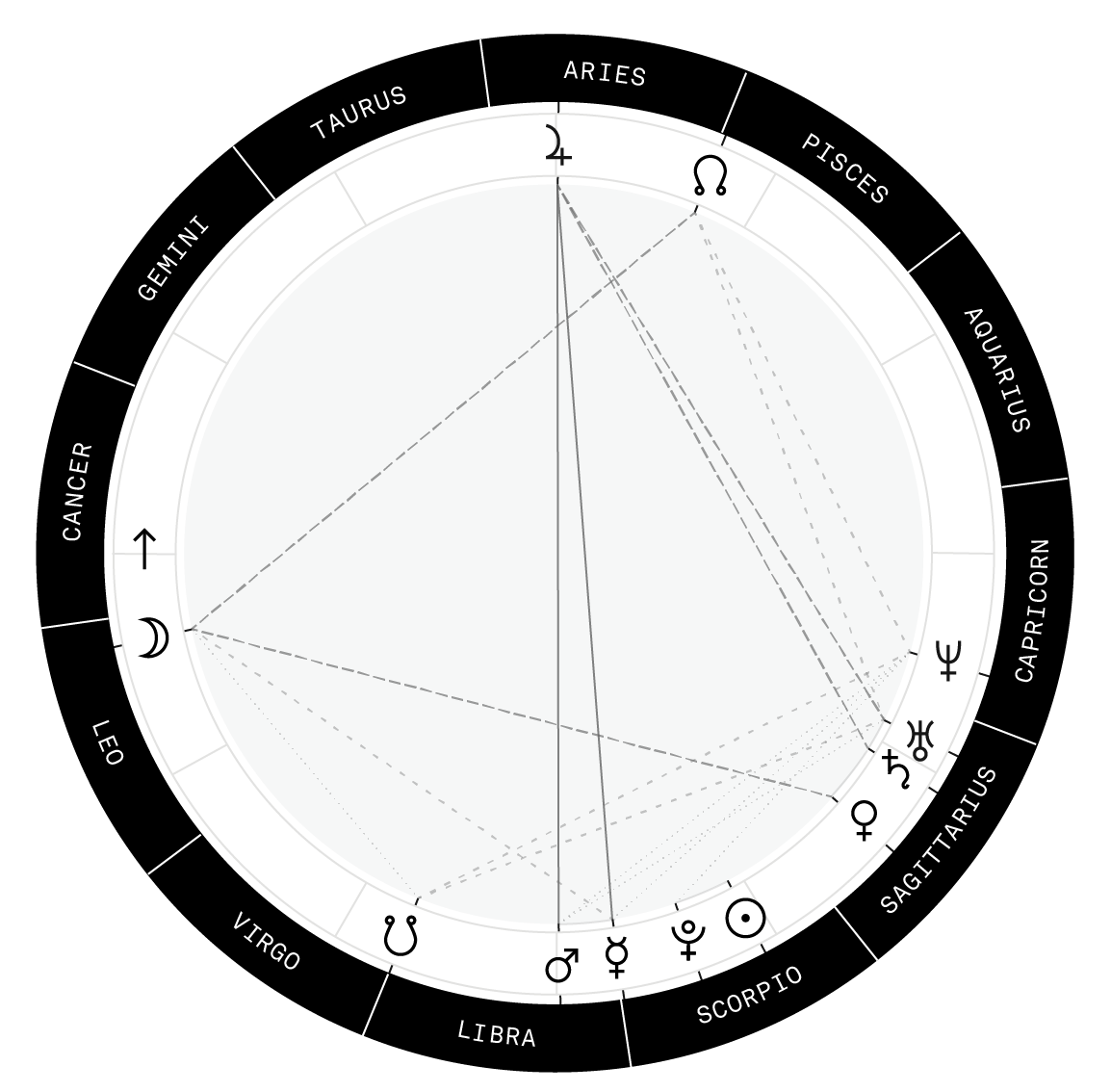
Image source: Co – Star
Beyond the planets, the chart is divided into 12 distinct sections called Houses. Each house represents a specific area of human experience. When a planet is located in a specific house, its energy is directed toward that area of your life. For example, the 2nd House governs personal finances and values, the 7th House rules committed partnerships and marriage, and the 10th House represents career and public reputation.
A comprehensive free horoscope will not just tell you that you have "Venus in Aries." It will explain what it means to have Venus in Aries located specifically in your 4th House of home and family, providing a highly targeted interpretation.
Which House System Should You Use for Your Horoscope?
A common point of confusion for users exploring different free horoscope sites is the discrepancy in house placements. You might generate a chart on one website and find your Sun in the 8th House, only to use a different app and see your Sun placed in the 9th House. This occurs due to the use of different "House Systems."
There is no single universally agreed-upon method for dividing the sky into twelve sections. The two most prominent systems encountered online are Placidus and Whole Sign.
Placidus is a quadrant-based system that divides the houses based on time and the intersection of the ecliptic. It became the modern standard largely due to the proliferation of printed ephemeris tables in the 20th century. In the Placidus system, houses can be of unequal sizes, meaning a single house might span multiple zodiac signs, or a sign might be entirely "intercepted" within a house.
Whole Sign is the older, traditional Hellenistic standard. In this system, the entire sign that was rising on the eastern horizon becomes the 1st House, the next sign becomes the 2nd House, and so on. Each house contains exactly 30 degrees and corresponds perfectly to a single zodiac sign.
If you find that the interpretations provided by a standard Placidus chart do not resonate with your lived experience, it is highly recommended to recalculate your chart using the Whole Sign system. Many modern practitioners and traditional astrologers find Whole Sign houses to be exceptionally clear for timing specific life events and understanding planetary rulerships.
Comparing Top Free Personalised Horoscope Tools Online
The internet offers a vast array of astrological calculators, but they vary significantly in their methodology, depth, and user interface. Selecting the right tool depends entirely on whether you are seeking psychological insight, daily transit tracking, or deep predictive analysis.
| Platform | System Type | Primary Strength | Report Depth |
|---|---|---|---|
| Astrotheme | Western (Placidus default) | Psychological depth and transit probability | Moderate (Detailed daily transits) |
| Astro-Seek | Western (Highly customizable) | Technical accuracy and advanced calculators | Extensive (Data-heavy, excellent for students) |
| AstroSage | Vedic (Sidereal) | Comprehensive AI-generated Kundli reports | Massive (Up to 250-page automated reports) |
| Indastro | Vedic (Sidereal) | Vimsottari Dasa timing system analysis | Deep (30-page structured analysis) |
| Co-Star | Western (AI-driven) | Modern phrasing and social integration | Bite-sized (Daily push notifications) |
For users seeking a traditional Western psychological approach, Astrotheme ranks among the top options, offering nuanced interpretations of how current transits affect your natal placements. If you prefer raw data and technical control over house systems and asteroids, Astro-Seek is widely regarded as a top-tier resource.
Conversely, if you are interested in Indian astrology (Jyotish), platforms like AstroSage and Indastro calculate your "Kundli" using the Sidereal zodiac, which accounts for the precession of the equinoxes. These Vedic tools are highly celebrated for their predictive timing systems, known as Dasas, which map out major life periods rather than just daily moods.
Image source: AstroSage
How to Use Zodiacal Releasing to Find Your Peak Life Chapters
While daily horoscopes focus on fleeting planetary weather, advanced astrological techniques can map out the overarching narrative arcs of your life. One of the most significant advancements in modern astrological practice is the revival of a Hellenistic timing technique known as Zodiacal Releasing.
Unlike standard transits, Zodiacal Releasing divides your life into distinct chapters and sub-chapters, allowing you to identify "Peak Periods" for career advancement, public recognition, and personal health. This technique relies heavily on calculating specific Arabic Parts, most notably the Lot of Fortune and the Lot of Spirit.
The technique breaks your timeline down into three primary levels:
These periods last anywhere from 8 to 30 years, depending on the zodiac sign ruling the period. An L1 chapter sets the overarching theme and backdrop for a significant portion of your adult life.
Lasting between several months to a few years, L2 periods indicate specific shifts in narrative, changes in career trajectory, or major relationship developments within the broader L1 context.
These are shorter periods lasting days to weeks, acting as the specific trigger points where the themes of L1 and L2 manifest into concrete, observable events.
To utilize this technique, you must first locate your Lot of Fortune, which is calculated using the longitudinal distance between your Sun, Moon, and Ascendant. When your Zodiacal Releasing periods align with the sign containing your Lot of Fortune (or the signs squaring or opposing it), you enter a "Peak Period." Many users find this method exceptionally strong for long-term career planning, as it indicates *when* your efforts are most likely to yield public recognition.
Should You Trust AI or Human-Authored Astrology Reports?
As artificial intelligence continues to integrate into consumer applications, the astrology sector has seen a massive influx of AI-generated reports. Tools synthesize NASA ephemeris data with natural language processing to generate instant, highly readable horoscopes. However, this raises a valid question regarding the depth and reliability of machine-generated interpretations compared to human expertise.
Platforms utilizing AI excel at synthesizing massive amounts of data instantly. They can cross-reference dozens of transits simultaneously and deliver the information in modern, conversational phrasing. AI is highly effective at providing immediate, bite-sized daily updates and identifying exact mathematical aspects down to the minute.
Reports written by expert astrologers (such as the renowned psychological reports by Liz Greene or Robert Hand) offer a level of nuance that machines struggle to replicate. Human authors understand the "probability of perception"—the idea that a difficult transit might manifest as an internal psychological shift rather than a fatalistic external event. They provide context, empathy, and thematic synthesis.
By most accounts, AI tools are an excellent choice for daily tracking and quick reference. However, for deep psychological profiling or navigating complex life transitions, reports structured by experienced human practitioners consistently offer stronger value and more compassionate guidance.
How to Protect Your Privacy When Using Astrology Apps
The requirement for precise birth data makes astrology apps inherently data-heavy. However, the rise of venture-backed, hyper-personalized astrology applications has introduced significant privacy concerns. Some modern platforms collect data far beyond what is necessary to calculate a natal chart.
When evaluating a free horoscope tool, it is crucial to distinguish between data required for astrological calculation and data harvested for behavioral profiling or advertising.
- Birth Date, Time, and Location: Necessary. This is the fundamental mathematical baseline required to generate a chart.
- Email Address: Standard for account creation and saving your chart data across sessions.
- Real-Time GPS Tracking: Unnecessary. Your current physical location is not required to read your natal chart or calculate general transits.
- Access to Contact Lists: Unnecessary. Some apps request this to build social networks within the platform, but it is entirely irrelevant to generating your personal horoscope.
- Cross-App Tracking Identifiers: Unnecessary. Used primarily for targeted advertising rather than astrological accuracy.
To maintain your privacy, consider using web-based calculators that do not require app installations or invasive permissions. Platforms that allow you to generate charts as a "guest" without creating a permanent profile are often the most secure options for casual exploration.
Frequently Asked Questions
The accuracy of a free horoscope depends entirely on the precision of the birth data provided and the quality of the software's ephemeris database. When exact birth times are used, the mathematical placement of the planets is highly accurate. However, the interpretation of those placements varies; astrology is best viewed as a tool for psychological reflection and probability, rather than fatalistic fortune-telling.
Western astrology typically uses the Tropical zodiac, which is based on the seasons and the vernal equinox. Vedic astrology (Jyotish) uses the Sidereal zodiac, which is tied to the fixed background of stars and accounts for the Earth's axial precession. As a result, your planetary signs in a Vedic chart will often be shifted backward by roughly 24 degrees compared to a Western chart.
If your Rising Sign changes between sites, it is usually due to one of two reasons: either the site is using a different time zone database (failing to account for historical Daylight Savings Time), or you are comparing a Tropical (Western) chart to a Sidereal (Vedic) chart. Always ensure the site uses a reliable database like the Swiss Ephemeris.
A Kundli is the traditional Indian term for a birth chart or natal chart. It maps the positions of the planets at the time of birth using the Vedic astrological system. Kundlis are heavily utilized in Indian culture for life predictions, career guidance, and assessing compatibility for marriage.
Yes, but it will be limited. You can generate a chart using an estimated time (like 12:00 PM) or a "Sunrise Chart," which will accurately show the positions of the slower-moving planets (Sun, Venus, Mars, Jupiter, etc.). However, you will not be able to determine your Rising Sign, exact Moon degree, or specific house placements.
Final Thoughts
Navigating the world of digital astrology requires moving past generic Sun sign readings and utilizing tools that process your exact birth data. By understanding the mechanics behind the charts, you can extract highly specific, actionable guidance for your daily life and long-term planning.
- Gather your exact birth time, date, and location before using any astrological calculator to ensure mathematical accuracy.
- Look beyond your Sun sign and analyze your "Big Three" (Sun, Moon, and Rising) for a more complete psychological profile.
- Experiment with different house systems, particularly Whole Sign versus Placidus, to see which framework aligns best with your lived experiences.
- Utilize advanced timing techniques like Zodiacal Releasing to identify long-term peak periods for career and personal growth.
- Protect your digital privacy by avoiding apps that request unnecessary access to your contacts or real-time location data.
Input your precise birth data into a reputable calculator today to map out your unique astrological blueprint.